


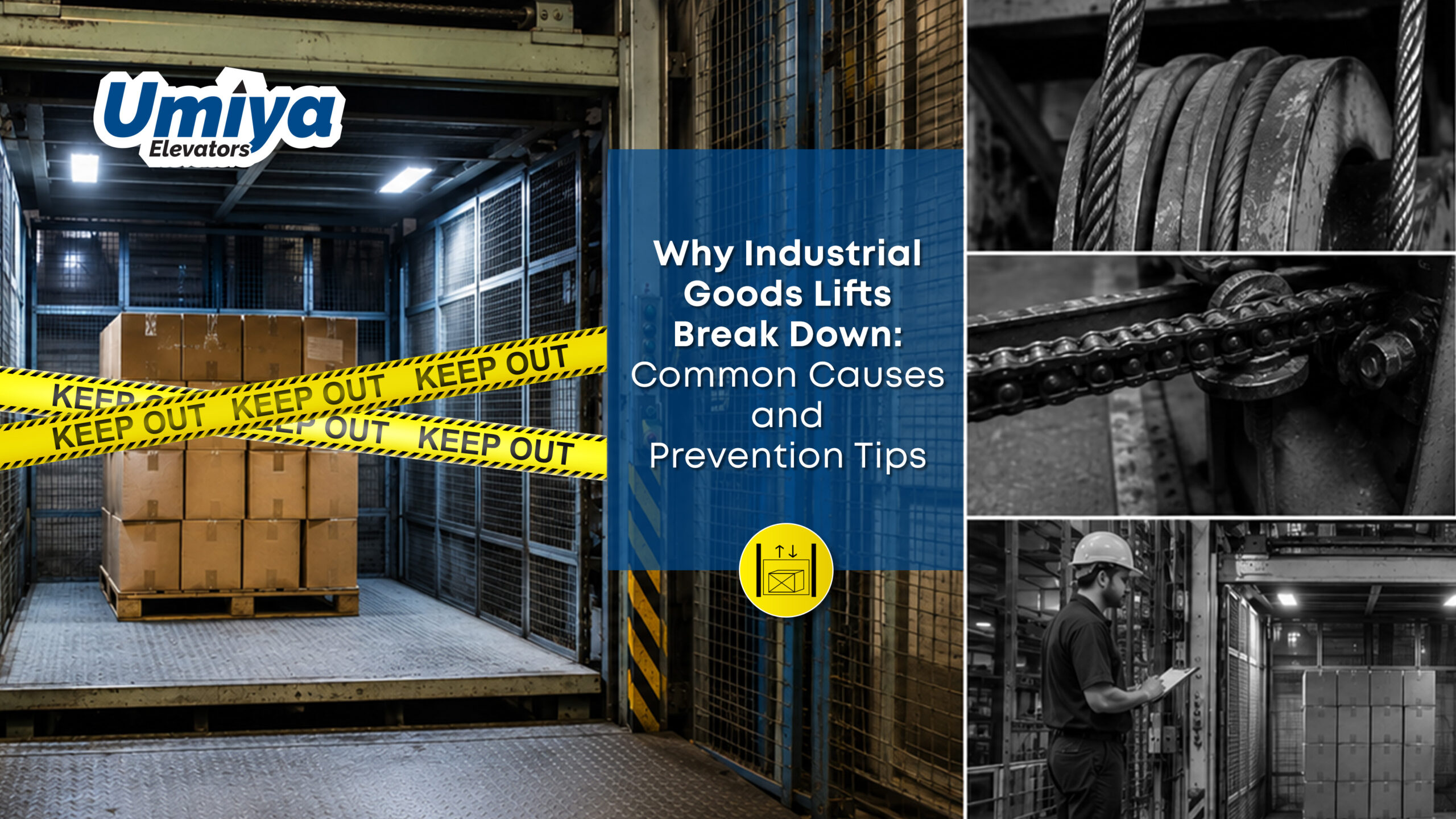
An industrial goods lift usually breaks down because of overloading, irregular maintenance, poor loading practices, door damage, control panel faults, or delayed servicing. In factories and warehouses, these issues can affect material movement, production flow, dispatch timelines, and worker safety.
For businesses in Ahmedabad and Gujarat, a goods lift is not just a lifting system. It is part of daily industrial operations. When it stops working, the impact can be immediate.
Regular lift AMC and proper inspection can prevent many breakdowns before they turn into major service problems. This guide explains the common causes of industrial goods lift failure and how businesses can keep their lift safer, smoother, and more reliable.
1. Why Do Industrial Goods Lifts Break Down in Factories and Warehouses?
Industrial goods lifts break down when the lift system is used beyond its designed capacity or maintained irregularly. These lifts handle heavy materials, cartons, tools, machine parts, pallets, and production goods throughout the day, which creates continuous pressure on mechanical and electrical parts.
Common causes of industrial goods lift breakdown include:
- Overloading beyond safe capacity
- Poor or delayed lift maintenance
- Rough loading and unloading
- Door lock or sensor problems
- Motor and control panel faults
- Electrical fluctuations
- Worn mechanical components
- Lack of preventive lift AMC
- Poor operator handling
- Weak service history
A reliable elevator company in Ahmedabad can inspect the lift and identify whether the problem is related to usage, installation, maintenance, or component wear.
For factories, the goal should not be only to repair the lift after failure. The better approach is to prevent breakdowns through regular inspection and planned maintenance.
2. How Does Overloading Damage an Industrial Goods Lift?
Overloading damages an industrial goods lift by putting extra pressure on the motor, lifting mechanism, platform, cabin structure, and safety systems. Even if the lift works for some time under excess weight, repeated overloading can reduce its performance and increase breakdown risk.
2.1 Motor and Lifting System Stress
The motor is designed to move a specific load safely. When the lift carries more weight than recommended, the motor works harder than it should.
This can lead to:
- Slow lift movement
- Motor heating
- Jerky operation
- Sudden stoppage
- Higher wear on lifting components
In industrial buildings, workers should be trained to follow load limits clearly. A lift should never be treated as unlimited carrying equipment.
2.2 Platform and Cabin Damage
Heavy or unevenly placed goods can affect the lift platform and cabin structure. If materials are placed only on one side or pushed roughly inside the lift, the system may experience imbalance.
This can cause:
- Vibration during movement
- Platform wear
- Door alignment issues
- Uneven lift travel
- Cabin damage over time
For safe material handling, goods should be placed evenly on the platform and within the recommended load capacity.
3. What Maintenance Mistakes Cause Goods Lift Failure?
The biggest maintenance mistake is waiting for the lift to break down before servicing it. Industrial goods lifts need preventive maintenance because they work under heavy load conditions and are often used repeatedly during the day.
Common maintenance mistakes include:
- Skipping scheduled service visits
- Ignoring unusual noise or vibration
- Not checking door locks and sensors
- Delaying motor and control panel inspection
- Not testing overload protection
- Using untrained technicians
- Not keeping service records
- Ignoring small faults during daily use
- Not choosing a proper lift AMC plan
Lift AMC helps factories and warehouses maintain the system through regular inspection, safety testing, lubrication where required, and early fault detection.
For industrial businesses, a lift breakdown can delay movement of raw materials, finished goods, and dispatch stock. Preventive maintenance is usually more practical than emergency repair.
4. Which Lift Parts Commonly Fail in Industrial Goods Lifts?
The parts that commonly fail in industrial goods lifts include doors, locks, sensors, control panels, motors, switches, brakes, and lifting components. These parts face regular pressure because the lift is used for heavy material movement.
4.1 Door Locks and Safety Sensors
Door systems are one of the most used parts of a goods lift. In factories and warehouses, doors may also face impact from trolleys, cartons, or material handling equipment.
Warning signs include:
- Door not closing fully
- Door reopening repeatedly
- Lift not starting after door closure
- Door making unusual noise
- Sensor not responding properly
Door problems should be checked quickly because they are directly connected to lift safety.
4.2 Control Panel and Electrical System
The control panel manages lift movement, stopping, leveling, and safety response. If the control system develops a fault, the lift may stop suddenly, respond slowly, or move unevenly.
Electrical issues can happen due to:
- Loose wiring
- Voltage fluctuation
- Aging components
- Poor maintenance
- Dust or industrial environment exposure
An experienced elevator company in Ahmedabad should check the control panel during routine lift AMC visits, especially in high-usage industrial buildings.
5. How Can Businesses Prevent Industrial Goods Lift Breakdowns?
Businesses can prevent industrial goods lift breakdowns by following safe load limits, training workers, maintaining the lift regularly, and choosing professional maintenance support. A goods lift should be treated as important industrial equipment, not just a basic lifting platform.
To reduce breakdown risk, factories and warehouses should:
- Follow the recommended load capacity
- Place goods evenly on the platform
- Avoid impact on lift doors and cabin walls
- Train workers on safe lift usage
- Keep the loading area clean
- Stop using the lift if repeated faults appear
- Schedule regular lift AMC visits
- Check noise, vibration, and slow response early
- Maintain service records
- Work with a reliable elevator company in Ahmedabad
A proper service visit should include motor inspection, door lock testing, sensor checks, control panel review, overload protection testing, movement observation, and general safety inspection.
For industrial spaces in Ahmedabad and Gujarat, timely maintenance can reduce downtime and improve long-term lift reliability.
Conclusion
Industrial goods lifts commonly break down because of overloading, poor maintenance, rough usage, door damage, control panel faults, electrical issues, and delayed servicing. These problems can affect factory workflow, warehouse movement, material handling, and daily productivity.
For businesses in Ahmedabad and Gujarat, regular lift AMC is one of the most effective ways to reduce breakdowns and improve lift safety. A dependable elevator company in Ahmedabad can inspect the system, identify early warning signs, and maintain the lift before small issues become major disruptions.
A well-maintained industrial goods lift supports safer operations, smoother material movement, lower downtime, and better long-term business efficiency.
FAQ
1. Why does an industrial goods lift break down often?
An industrial goods lift often breaks down because of overloading, irregular maintenance, rough handling, door issues, motor strain, control panel faults, or lack of preventive servicing.
2. How can lift AMC prevent goods lift breakdowns?
Lift AMC helps prevent breakdowns through regular inspection, motor checks, door testing, control panel review, overload protection testing, lubrication, and early fault detection.
3. What are the early warning signs of goods lift failure?
Common warning signs include unusual noise, jerky movement, slow response, vibration, door closing issues, repeated stoppage, uneven leveling, and sudden shutdown.
4. Should a factory stop using the lift after repeated faults?
Yes. If an industrial goods lift shows repeated faults, it should be inspected by trained technicians before regular use continues. Continued use may increase safety and breakdown risks.
5. How do I choose the right elevator company in Ahmedabad for goods lift maintenance?
Choose a company with experience in industrial goods lifts, trained technicians, local service support, clear lift AMC terms, spare parts availability, and a proper safety inspection process.
6. What is the most common cause of industrial goods lift failure?
Overloading and irregular maintenance are among the most common causes. Both put pressure on the motor, platform, control panel, door system, and safety components.
7. How often should an industrial goods lift be serviced?
Service frequency depends on usage, load movement, lift age, and working environment. High-usage factories and warehouses usually need more frequent inspection than low-usage buildings.