


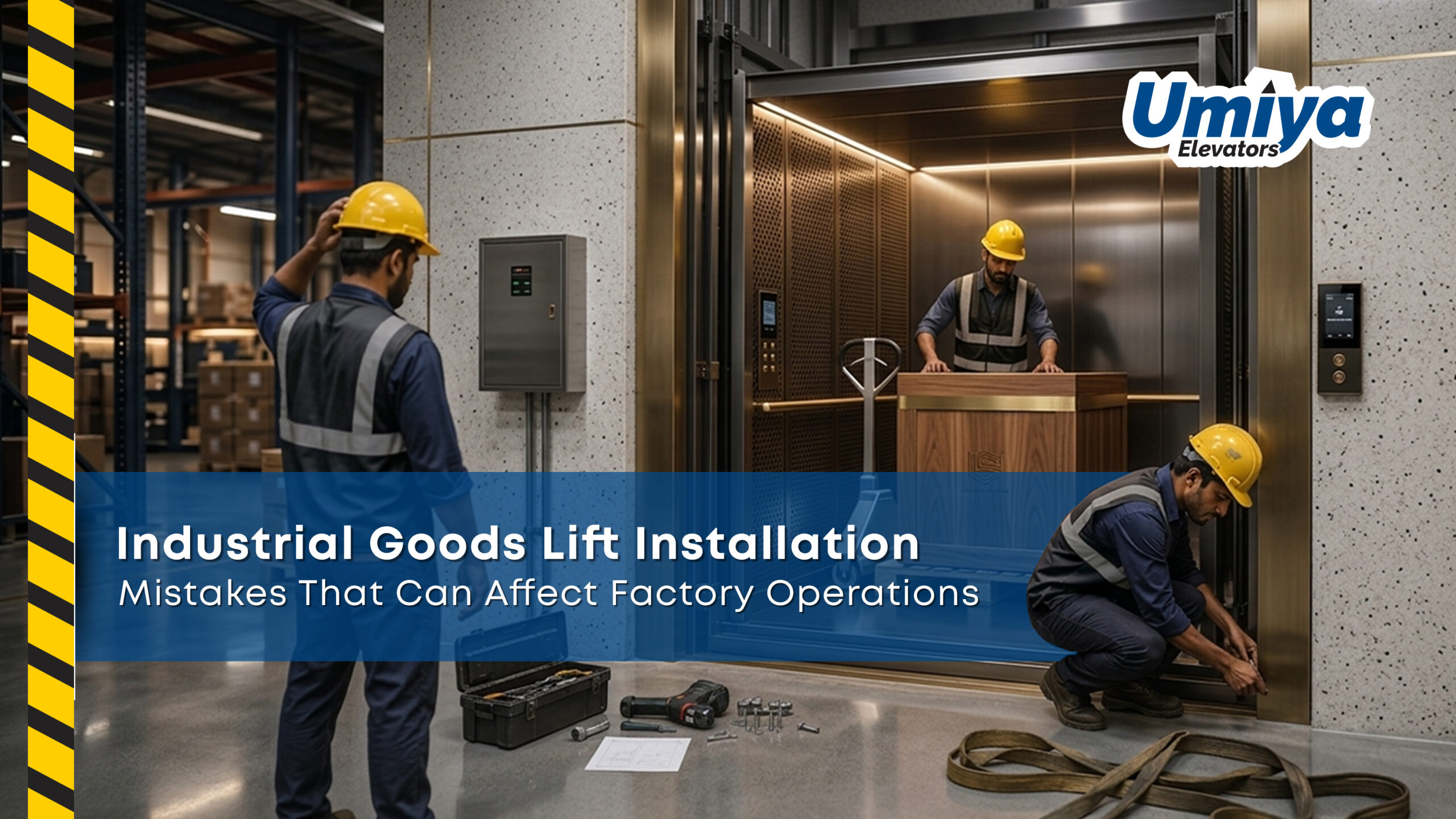
An industrial goods lift supports safe vertical material transportation in factories, warehouses, workshops, storage units, and manufacturing buildings. It helps move raw materials, finished goods, cartons, tools, machine parts, pallets, and heavy loads between floors without depending fully on manual handling.
However, if an industrial goods lift is not planned or installed properly, it can affect factory operations instead of improving them. Wrong capacity selection, poor lift placement, weak loading access, missing safety features, and lack of lift AMC planning can lead to downtime, workflow delays, safety risks, and repeated maintenance issues.
For factories and warehouses in Ahmedabad and Gujarat, choosing the right elevator company in Ahmedabad is important because industrial lift installation requires practical site understanding, load planning, safety inspection, and long-term service support.
1. Choosing the Wrong Load Capacity
Choosing the wrong load capacity is one of the most common industrial goods lift installation mistakes. Load capacity decides how much weight the lift can safely carry in one trip. If the selected capacity is lower than actual factory usage, the lift may face motor strain, slow movement, jerky travel, frequent stoppage, and higher breakdown risk.
Before selecting an industrial goods lift, factory owners should evaluate:
- Average load per trip
- Maximum expected load
- Type of goods being moved
- Cartons, pallets, trolleys, tools, or machinery parts
- Frequency of daily movement
- Number of floors served
- Future production or storage growth
- Loading and unloading method
- Platform size requirement
- Door opening width
The lift should be selected based on real material handling needs, not only on current minimum usage. A factory moving machine parts will need a different lift capacity than a warehouse moving packed cartons.
A reliable elevator company in Ahmedabad should inspect the site, study the goods movement pattern, and recommend a lift capacity that supports both current and future operations.
2. Poor Lift Placement Inside the Factory
Poor lift placement affects factory operations because it decides how quickly goods can move between production, storage, loading, and dispatch areas. Even a technically strong industrial goods lift may not improve workflow if it is installed in the wrong location.
2.1 Lift Too Far from Loading and Dispatch Areas
An industrial goods lift should be placed close to actual material movement zones. If the lift is far from loading bays, dispatch areas, stockrooms, or production floors, workers may still spend extra time moving goods manually.
This can increase handling time, create congestion, and reduce the operational benefit of the lift.
2.2 Poor Connection Between Production and Storage Floors
Factories often need smooth movement between production areas, raw material storage, finished goods storage, and packing sections. If the lift does not connect these zones properly, the workflow becomes inefficient.
Proper lift placement improves vertical material movement and reduces unnecessary back-and-forth handling.
2.3 Limited Access for Trolleys and Pallets
Many factories and warehouses use trolleys, carts, pallet trucks, or material handling equipment. If the lift entry point is narrow or the platform is not aligned properly, loading and unloading becomes difficult.
The installation layout should allow safe trolley movement, easy platform access, and clear movement space around the lift.
3. Ignoring Safety Features During Installation
Ignoring safety features during industrial goods lift installation can increase the risk of material damage, worker injury, breakdowns, and unsafe operation. Since goods lifts carry heavy loads, safety systems should be planned before installation, not added later.
Important safety features include:
- Overload protection system
- Emergency stop mechanism
- Door interlock system
- Safety sensors
- Stable platform movement
- Strong cabin or platform structure
- Proper electrical safety setup
- Clear operating controls
- Secure door locking system
- Safe loading and unloading design
- Warning indicators where required
- Smooth start and stop operation
For industrial buildings, safety is not only about movement between floors. It also includes how goods are loaded, whether the door closes safely, whether the lift stops at the correct level, and whether the system prevents unsafe operation under overload.
A professional elevator company in Ahmedabad should explain these safety systems clearly and include them as part of the installation plan.
4. Not Planning Maintenance Access and Lift AMC
Not planning maintenance access is a serious mistake because industrial goods lifts need regular inspection due to heavy load movement and frequent use. A lift may work properly after installation, but without preventive maintenance, small issues can turn into downtime and costly operational delays.
4.1 No Space for Service Access
Technicians need proper access to inspect motors, control panels, doors, sensors, wiring, and mechanical components. If the lift is installed in a tight or poorly planned area, servicing becomes difficult.
Limited service access can increase maintenance time and disturb factory operations during inspection or repair.
4.2 No Lift AMC Planning from Day One
Lift AMC should be discussed before installation because industrial lifts require structured preventive maintenance. AMC helps detect early problems before they become serious breakdowns.
A good lift AMC plan for an industrial goods lift may include:
- Motor performance check
- Control panel inspection
- Door lock and sensor testing
- Overload protection testing
- Platform stability check
- Movement quality inspection
- Electrical component review
- Lubrication where required
- Safety system testing
- Service report after inspection
4.3 Delayed Response to Early Warning Signs
Factories should not ignore warning signs such as unusual noise, vibration, slow movement, door problems, uneven leveling, or repeated stoppage. These signs often indicate deeper issues in the motor, control system, door mechanism, or load handling components.
Regular lift AMC helps reduce lift downtime and improves long-term reliability.
5. Selecting a Lift Partner Based Only on Price
Choosing a lift provider only because of the lowest quotation can create long-term problems. Industrial goods lift installation requires load study, site inspection, safety planning, installation expertise, and maintenance support. A low initial price may not be useful if the lift later causes breakdowns, unsafe movement, or repeated service issues.
Before finalizing a provider, factory owners should check:
- Experience with industrial goods lift projects
- Understanding of factory and warehouse workflows
- Proper site inspection process
- Load capacity guidance
- Platform size and door width planning
- Knowledge of trolley and pallet movement
- Safety feature explanation
- Installation team capability
- Customization options
- Local service support in Ahmedabad
- Lift AMC availability
- Spare parts support
- Clear warranty and documentation
A dependable elevator company in Ahmedabad should guide businesses based on factory operations, not just product specifications. For industrial projects in Gujarat, local service response and technician availability also matter because lift downtime can affect production and dispatch schedules.
Conclusion
Industrial goods lift installation affects factory operations, material movement, worker safety, and long-term productivity. Mistakes such as wrong load capacity, poor lift placement, limited trolley access, missing safety systems, and no lift AMC planning can create delays, breakdowns, and avoidable maintenance issues.
For factories and warehouses in Ahmedabad and Gujarat, proper planning is essential before installation. A reliable elevator company in Ahmedabad should inspect the site, understand factory material handling, recommend the right lift capacity, plan safe loading access, and provide preventive maintenance support.
A well-installed industrial goods lift improves vertical goods movement, reduces manual handling, supports safer workflow, and helps factory operations run with fewer interruptions.
FAQ
1. What is the biggest mistake during industrial goods lift installation?
The biggest mistake is choosing the wrong load capacity. If the lift capacity does not match actual material weight and usage frequency, it can lead to motor strain, slow movement, breakdowns, and safety issues.
2. Why does lift placement matter in factories?
Lift placement matters because it affects how quickly goods move between production, storage, loading, and dispatch areas. Poor placement can increase manual handling and reduce workflow efficiency.
3. What should be checked before installing an industrial goods lift?
Before installation, businesses should check load capacity, platform size, door width, loading access, shaft space, floor alignment, safety features, electrical readiness, service access, and lift AMC support.
4. What safety features should an industrial goods lift include?
An industrial goods lift should include overload protection, emergency stop system, door interlock system, safety sensors, secure door locking, stable platform movement, and proper electrical safety setup.
5. Why is lift AMC important after installation?
Lift AMC is important because it helps prevent breakdowns through regular inspection, motor checks, control panel review, door testing, safety system checks, and early fault detection.
6. Can poor installation affect factory operations?
Yes. Poor installation can cause slow material movement, unsafe loading, frequent breakdowns, workflow delays, production interruptions, and higher maintenance dependency.