


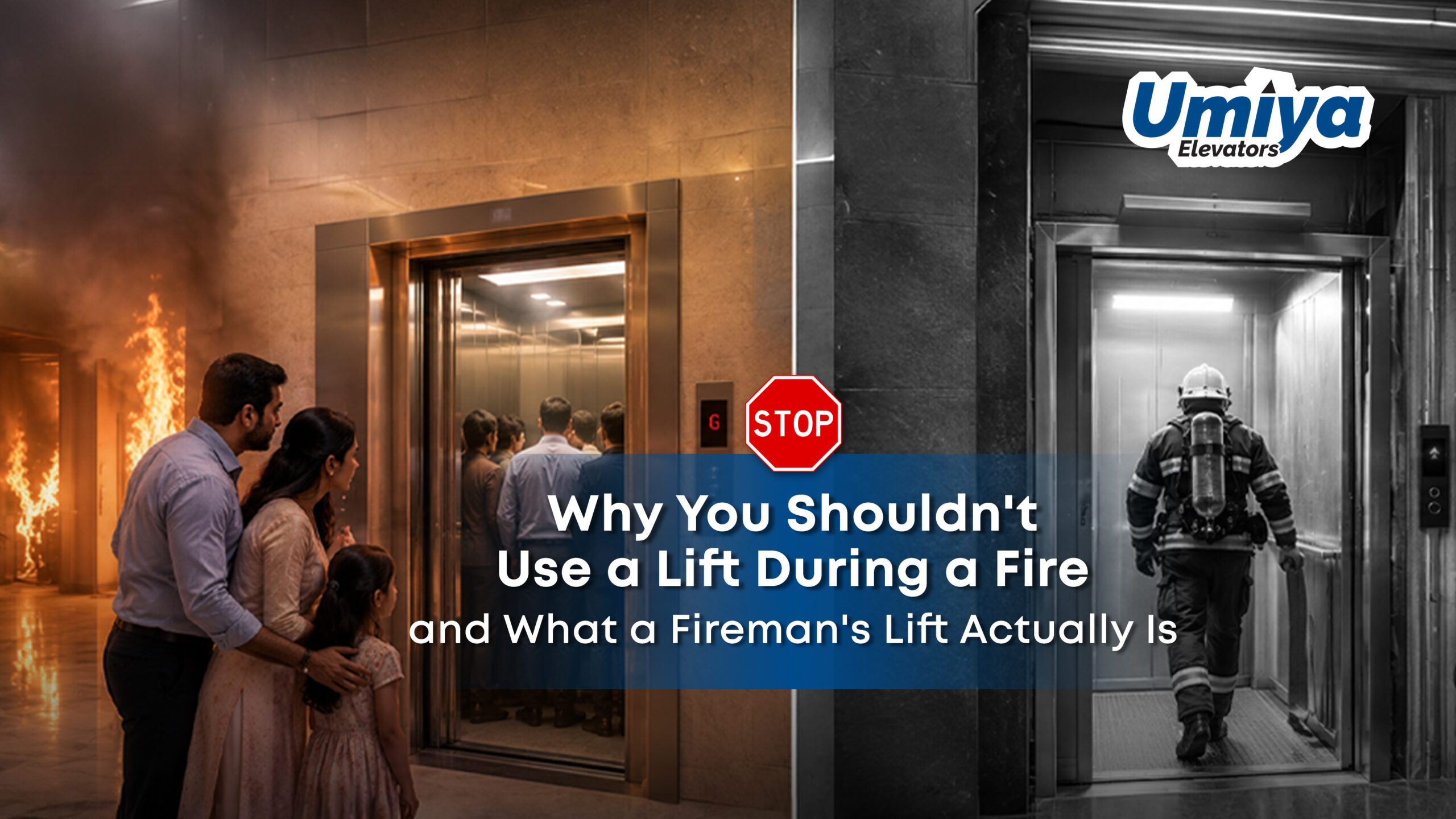
During a fire, many people instinctively think of using the lift to get down quickly. It feels faster than stairs, especially in high-rise apartments, commercial buildings, hospitals, hotels, and offices. But in most fire situations, using a normal passenger lift can be dangerous.
This is why building owners, residents, builders, and society committees should understand the difference between a regular passenger lift and a fireman’s lift. Responsible passenger lift manufacturers also guide clients about fire-mode operation, safety systems, and correct lift usage during emergencies.
Why should you not use a normal lift during a fire?
A normal passenger lift is designed for everyday movement, not emergency fire evacuation. During a fire, several things can go wrong.
Smoke may enter the lift lobby or shaft. Power supply may fail. The lift may stop between floors. Doors may open on a floor affected by fire or smoke. Firefighting water may also affect electrical systems.
This is why most buildings display instructions such as “Do not use lift in case of fire.” The safer evacuation route is usually the staircase, as guided by the building’s fire safety plan and local authority instructions.
What happens if someone uses a lift during a fire?
Using a normal lift during a fire can create serious risk. The lift may not respond normally because fire alarm systems, power supply, smoke detection, or emergency controls may change how the lift operates.
Possible risks include:
- Lift stopping unexpectedly
- Doors opening at an unsafe floor
- Smoke entering the lift area
- Power interruption during movement
- Delayed rescue if the lift gets stuck
- Blocking fire service access
This is why residents and building users should be trained to avoid lifts during fire emergencies.
What is a fire-mode operation in a lift?
Fire-mode operation is a safety function that changes how the lift behaves during a fire alarm or fire service activation.
In simple terms, the lift stops working like a normal passenger lift. It may cancel regular calls, ignore floor buttons, and move to a designated evacuation floor, usually the ground floor or main exit floor.
The goal is to prevent normal users from calling or using the lift during a fire situation.
Different buildings may have different fire control designs, so the exact operation should always be confirmed with the lift provider, fire consultant, and local authority.
What is ground floor homing?
Ground-floor homing means the lift automatically returns to the main evacuation floor when fire-mode operation is activated.
For many buildings, this is the ground floor. In some cases, it may be another designated evacuation level based on building design.
Once the lift reaches that floor, it may remain parked with doors open or become unavailable for normal passenger use. This helps prevent people from unknowingly entering a lift during fire conditions.
Good passenger lift manufacturers should clearly explain how ground-floor homing works in the supplied lift system.
What is a fireman’s lift?
A fireman’s lift is a specially designed lift intended for use by firefighters during fire emergencies. It is not the same as a regular passenger lift.
Its purpose is to help trained fire personnel move equipment and reach upper floors more efficiently during emergency response.
A fireman’s lift is usually planned as part of the building’s fire and life safety system. It may include special controls, protected access, communication features, fire service switch, backup power arrangements, and integration with fire safety systems as required by the building design and applicable rules.
Can residents use a fireman’s lift during a fire?
No, a fireman’s lift is not meant for general residents or visitors to use during a fire unless specifically directed by emergency personnel.
It is controlled for firefighting operations. Once fire service mode is activated, normal passenger use is restricted.
Residents should follow evacuation instructions, use staircases, and avoid lift lobbies unless guided otherwise by building safety teams or fire authorities.
How is a normal passenger lift different from a fireman’s lift?
A normal passenger lift is designed for the daily movement of people. It focuses on comfort, accessibility, cabin design, smooth movement, and regular building usage.
A fireman’s lift is designed for emergency fire service operation. It supports trained firefighters, equipment movement, and controlled access during fire response.
The key differences are:
- Normal lifts are for daily passenger movement
- Fireman’s lifts are for fire service use
- Normal lifts should not be used during fire evacuation
- Fireman’s lifts have special emergency controls
- Fireman’s lifts may be connected with fire safety systems
- Fireman’s lifts require specific planning during building design
This difference should be understood clearly by builders, societies, and commercial property owners.
Why does fireman’s lift planning matter for builders?
Fireman’s lift planning should not be treated as an afterthought. In larger buildings, fire safety planning affects lift location, lobby design, electrical planning, control systems, emergency access, and compliance requirements.
Builders should coordinate with:
- Architects
- Fire consultants
- Electrical consultants
- Lift providers
- Local approval authorities
Experienced passenger lift manufacturers can help with lift-related technical planning, but fire safety design should always follow applicable regulations and expert guidance.
What should housing societies teach residents?
Many fire emergencies become more dangerous because residents panic or do not know what to do.
Society committees should educate residents about:
- Not using lifts during fire
- Using staircases for evacuation
- Avoiding smoke-filled lift lobbies
- Not forcing lift doors
- Following fire alarm instructions
- Keeping lift areas clear
- Allowing firefighters access to designated lifts
Simple awareness messages in lift lobbies can make a major difference during emergencies.
What should building owners check in lift maintenance?
Fire-related lift functions should not only be installed. They must also be maintained and tested as part of the building’s safety routine.
Owners should check:
- Fireman switch condition
- Emergency alarm system
- Communication system where provided
- Door operation
- Backup power interface
- Ground-floor homing function
- Fire-mode operation response
- Lift controller condition
These checks should be handled by trained lift professionals. Any fault in emergency operation should be corrected quickly.
What should you ask passenger lift manufacturers before installation?
Before finalizing a lift for a residential or commercial building, ask these questions:
- Does the lift support fire-mode operation?
- How does ground-floor homing work?
- Is a fireman switch required for this building?
- What happens when the fire alarm is activated?
- Does the lift integrate with the building fire system?
- What emergency communication features are available?
- What maintenance checks are needed after installation?
- What documentation will be provided?
Reliable passenger lift manufacturers should be able to explain these points in simple language.
Why should fire safety not be ignored after installation?
A lift may be installed correctly, but poor maintenance can affect emergency readiness. Fire-mode operation, switches, doors, control systems, and backup interfaces must remain functional over time.
Building owners should include these checks in regular lift maintenance. For high-use buildings such as hospitals, offices, hotels, apartments, and commercial complexes, this is especially important.
Conclusion
A normal lift should not be used during a fire because it is not designed for public fire evacuation. Smoke, power failure, unsafe floor opening, and control changes can create serious risk.
A fireman’s lift is different. It is a specially planned lift for trained fire service personnel and emergency response. It may include fire-mode operation, ground-floor homing, special controls, and integration with building fire safety systems.
For builders, societies, and commercial property owners, the key lesson is simple. Work with experienced passenger lift manufacturers, plan fire-related lift functions properly, maintain them regularly, and educate users clearly. During a fire, the right lift knowledge can protect both people and emergency responders.